PolicySoup: Because "Read the Bill" Shouldn't Require a Law Degree
Or: why we built the thing we desperately wished existed.
You know that feeling when Congress is apparently doing something huge - it’s all over your timeline, everyone’s screaming, half your friends are calling it the end of civilization and the other half are saying it’s long overdue - and you just want to know what the thing actually says?
You Google it. You land on Congress.gov, stare at a wall of procedural jargon, and quietly close the tab.
We’ve been there. We are there. And we built PolicySoup to fix it.
What Is PolicySoup?
PolicySoup is a civic-transparency platform that tracks US congressional legislation, nominations, and votes - and then actually explains them to you, in plain English, without assuming you minored in political science or have a spare afternoon to decode subcommittee discharge procedures.
Think of it as the difference between a raw medical report and a doctor who sits down with you and goes: “OK, here’s what this means for your life.”
Let’s Talk About the Competition
GovTrack, Congress.gov, and the Hall of Noble Intentions
Existing bill-tracking sites are genuinely valuable. They’re authoritative. They’re comprehensive. They are also, bless their hearts, about as readable as a tax form stapled to another tax form.
Want to know if H.R. 1234 affects you? Great. Here’s the full committee markup, the engrossed version, the enrolled version, three procedural amendments, and a PDF from 2003 you’ll definitely need to cross-reference. Good luck!
These sites were built for the policy machine - by it and for it. If you’re a Congressional staffer or a lobbyist who does this all day, they’re fine. For everyone else, they’re a wall with a door that requires a special key nobody gave you.
The Social Media Void
On the other end of the spectrum: social media. Where discourse goes to die screaming.
You’ve seen it. Someone posts: “THIS BILL WILL DESTROY AMERICA” with zero context, a screenshot of two sentences out of a 400-page document, and 800 replies from people who also haven’t read the bill, but are very confident about it.
The problem with political commentary on X or Bluesky isn’t that people are talking - it’s that they’re talking into the void. No shared facts. No common reference point. No way to say “wait, what does the bill actually say about that?”
Every discussion is its own little firestorm, disconnected from anything real, while the actual legislation chugs along in the background, largely unexamined.
PolicySoup Does Something Different
Here’s what we actually built:
Plain-Language AI Summaries
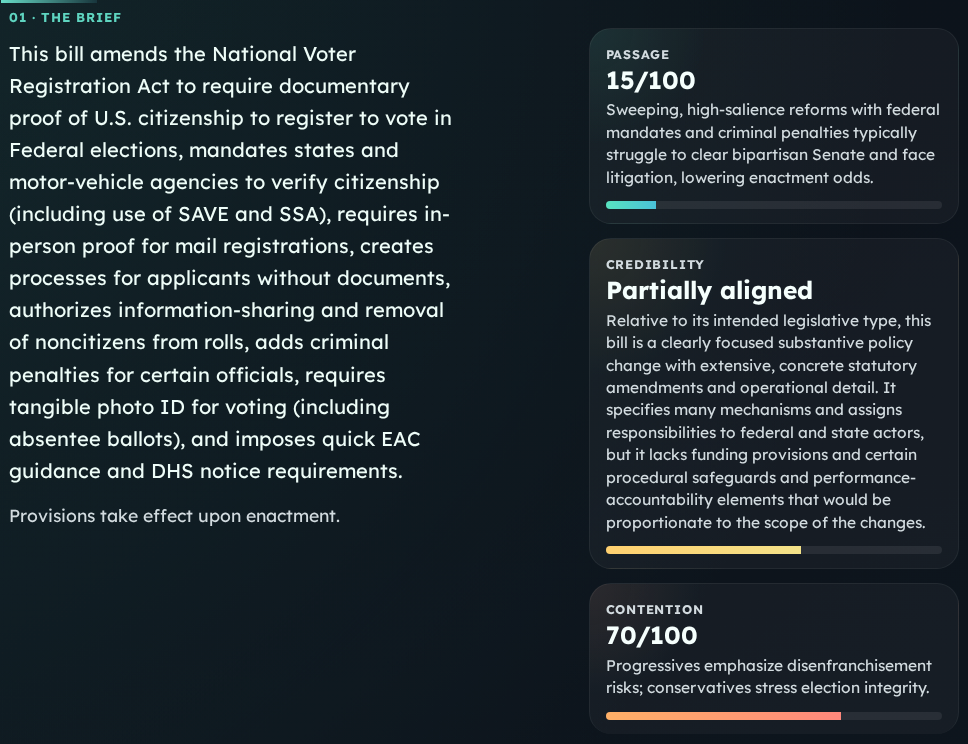
Every bill gets a neutral, plain-English brief that tries to answer the first question fast: what does this actually do? Not sponsor spin. Not opponent spin. Not our preferred conclusion. Just a readable explanation of the proposal, the mechanics, and the stakes.
Real-World Impact Analysis
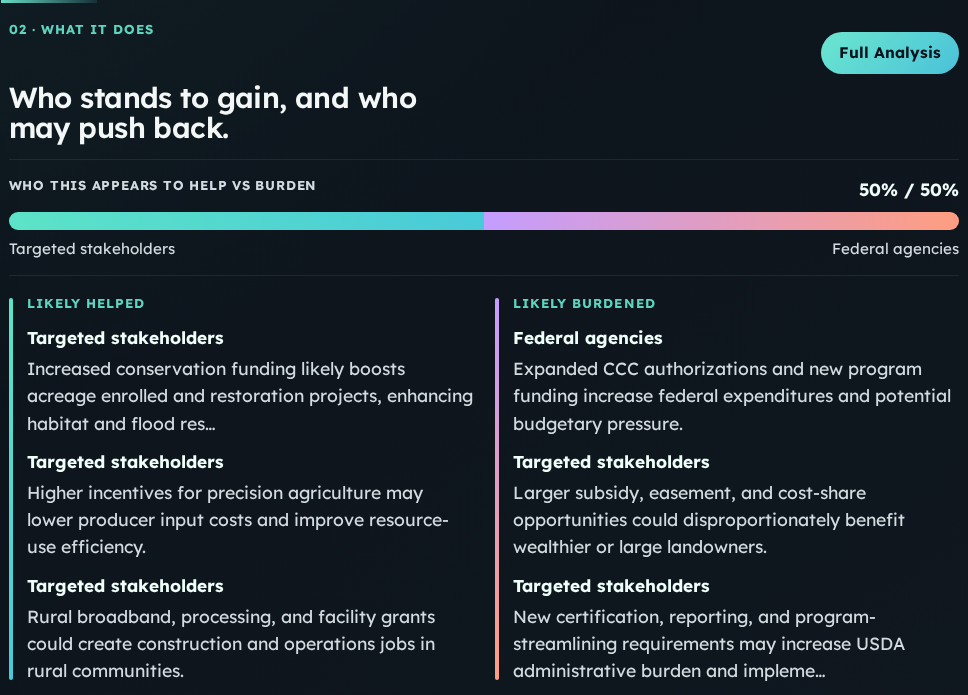
After the summary, we go deeper. We break down a bill’s likely effects across taxpayer, social, economic, government, and foreign-policy lenses so you can see who may benefit, who may absorb costs, and where the implementation burden lands.
That is not us telling you what your opinion should be. It is us trying to make the tradeoffs visible enough that you can bring your own values to the page.
Three Perspectives, Honestly Presented
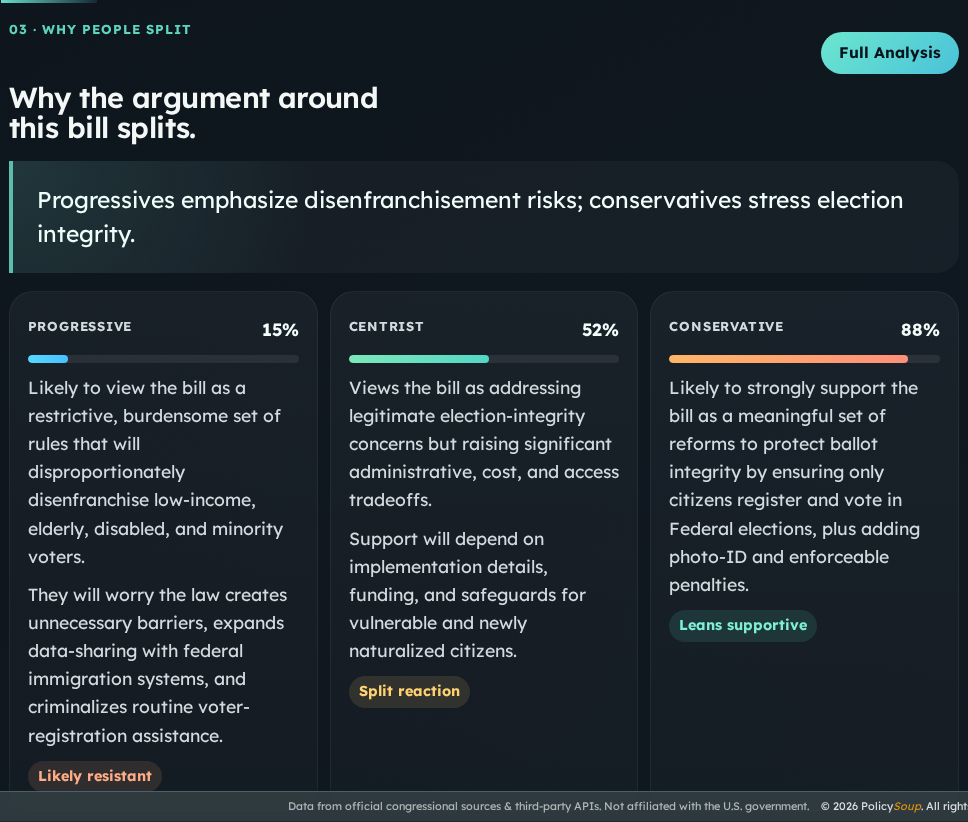
Here’s something we’re proud of: our multi-perspective analysis. For any given bill, we generate how a Progressive, a Centrist, and a Conservative would likely see it - what they’d see as benefits, what would concern them, how much they’d likely support it.
We’re not trying to tell you what to think. We’re trying to show you why smart, reasonable people might land in different places on the same piece of legislation. The point is not fake symmetry. The point is to surface the real places where values, priorities, and risk tolerance diverge.
Is This Bill for Real, or Just a Headline?
Here’s something nobody else bothers to tell you: a huge percentage of bills filed in Congress are never meant to pass. They exist to generate outrage, fundraising emails, and social media engagement. They’re messaging vehicles dressed up as legislation.
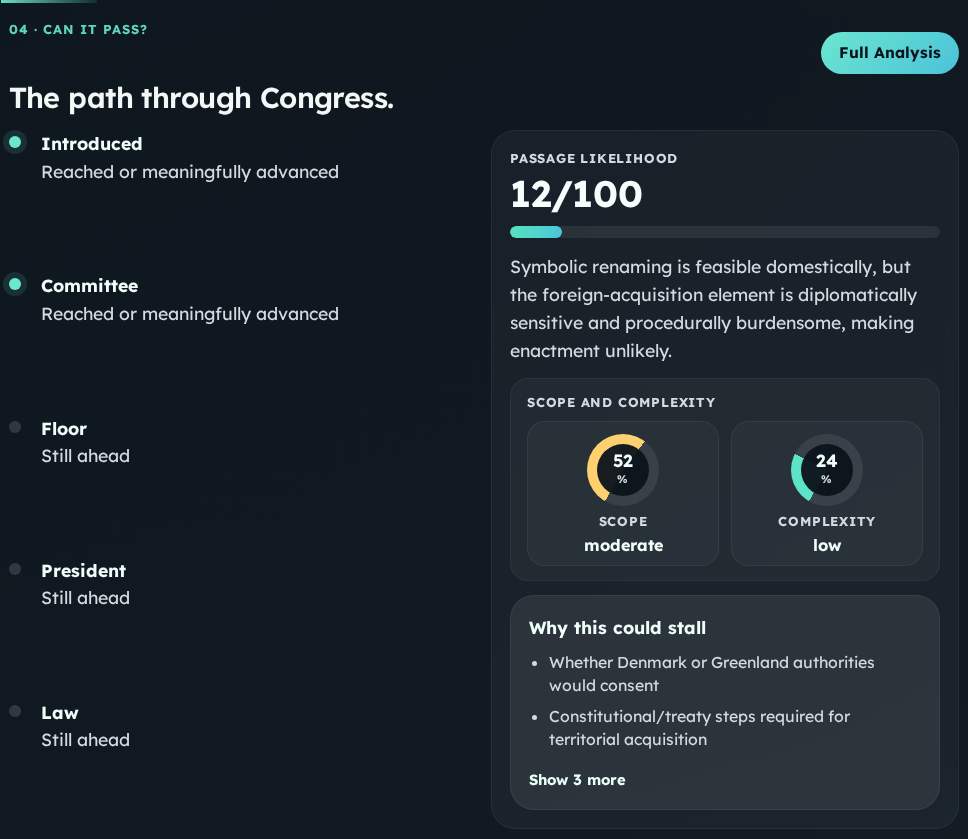
Take H.R. 1161, the “Red, White, and Blueland” Greenland annexation bill. It made for great cable-news bait. It also carries a 12/100 passage outlook and runs straight into obvious diplomatic, procedural, and consent problems. We do not need to stamp it with a giant BAD BILL label for the shape of the thing to become clear.
PolicySoup has a messaging risk signal baked into our bill analysis. We look at whether a bill’s scope, structure, and policy substance actually match its stated ambitions - or whether it looks more like a press release wearing a bill’s clothes.
We’ll never tell you a bill or nomination is flatly “good” or “bad.” We try to show enough evidence, enough context, and enough uncertainty that the answer becomes hard to miss without us doing the thinking for you.
Passage Likelihood
“Will this bill actually go anywhere?” is usually the most important question nobody answers. Our AI-powered passage scoring covers both the House and Senate - so you can quickly tell the difference between a bill that has a real shot and one that’s basically a fundraising tool someone filed to look busy.
It’s not prophecy. It’s a seriousness check.
The SoupScore
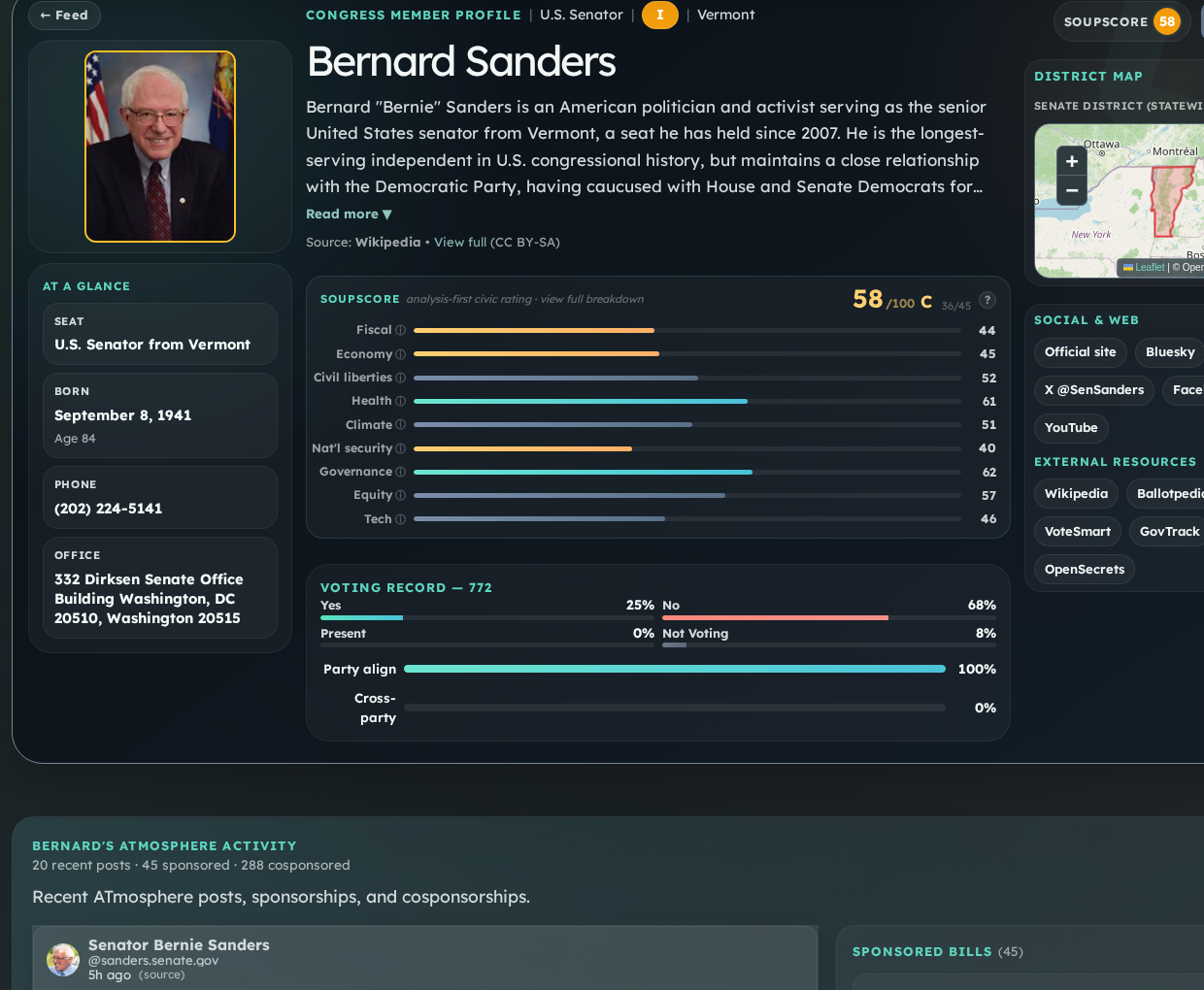
PolicySoup grades legislators with a SoupScore - a 0–100 signal (with a letter grade from F to A) that tries to answer a simple question: “What kind of bills does this person actually drive?”
It’s not just about how often they show up to vote. SoupScore looks at the bills an elected official sponsors and measures: how bipartisan their appeal tends to be, the net direction of their fiscal and civil-liberties impacts, and - crucially - the “grandstanding vs. governing” ratio. Are they sponsoring legislation that could realistically do something, or are they mostly filing bills designed to generate headlines?
It’s a beta metric and we’re transparent about how it’s calculated (click the score on any legislator page to see the full breakdown). But it’s already a useful gut-check when you want to know whether your representative is actually doing the job.
News, Attached to Actual Bills
We match relevant news articles directly to the bills they’re about. No more “saw something about a bill somewhere” - the coverage is right there, connected to the legislation, so you can see what reporters are actually saying about it and then read the bill itself.
Bluesky Discussions, Anchored to Reality
PolicySoup is built on the AT Protocol (the same open protocol that powers Bluesky). When you discuss a bill on PolicySoup, that discussion is posted to Bluesky - but it’s anchored to the specific bill.
So instead of screaming into the void, you’re contributing to a discussion that’s tied to an actual piece of legislation, with the bill’s text and analysis right there in context. Future readers can see what the bill says and what people thought about it, in the same place.
Follow the People Who Vote for You
Look up your representatives by state, district, or GPS. Follow them. See their voting records. See how similar (or not) their voting patterns are to other legislators. The similarity matrix is a fascinating rabbit hole - turns out “bipartisan” is doing a lot of work in political rhetoric that the actual vote data doesn’t always support.
Your Personal Legislative Feed
Follow bills and legislators you care about and get a personalized activity feed. Not an algorithm trying to maximize your outrage - just: “here’s what happened with the things you asked to watch.”
No Ads. No Algorithmic Outrage. No Hidden Agenda.
PolicySoup is free to use and there are no ads. We’re not selling your attention to anyone. The site exists to inform, not to inflame.
For people who want to go deeper - more detailed analysis, extended history, the full power-user toolkit - there’s a Pro account. That’s how we keep the lights on. But the core experience is free, clean, and unmonetized by outrage.
Who Is This For?
If you’ve ever:
- Wanted to actually understand a bill you kept seeing headlines about
- Suspected that the “both sides” framing you get from news might be flattening something complicated
- Been frustrated that your only options were “read 400 pages of legalese” or “trust that reply guy on X”
- Wasted emotional energy on a bill that turned out to be pure performance and never had a chance of passing
- Cared about what Congress is doing but felt like the whole system was designed to be impenetrable
- Just wanted one website that treats you like an adult who can handle nuance
…PolicySoup was built for you.
We’re Honest About What We Are
PolicySoup is an independent project. We’re not affiliated with any party, PAC, media company, or government entity. The AI analysis is explicitly designed to be neutral in its summaries and multi-perspectival in its analysis - not “both sides” in the lazy journalistic sense, but genuinely trying to represent how different people actually think about policy tradeoffs.
We don’t always get it perfect. The AI summaries are based on the actual bill text and they can miss wider political context. Passage scores are predictions, not prophecy. SoupScores are beta and data-dependent. We’ll tell you when we’re uncertain - and that’s kind of the whole point.
We’re also always adjusting and improving. If a score looks off, a framing looks incomplete, or a bill reads differently to someone with real subject-matter expertise, we want to hear that criticism. This product should improve under scrutiny, not hide from it.
What we won’t do: pretend legislation is simpler than it is, pretend predictions are certainty, or reduce a bill or nomination to a thumbs-up/thumbs-down sticker.
Try It
The soup is hot. Dive in.
Congress is doing things whether you’re paying attention or not. PolicySoup makes it a lot easier to pay attention - and a lot harder to be manipulated.